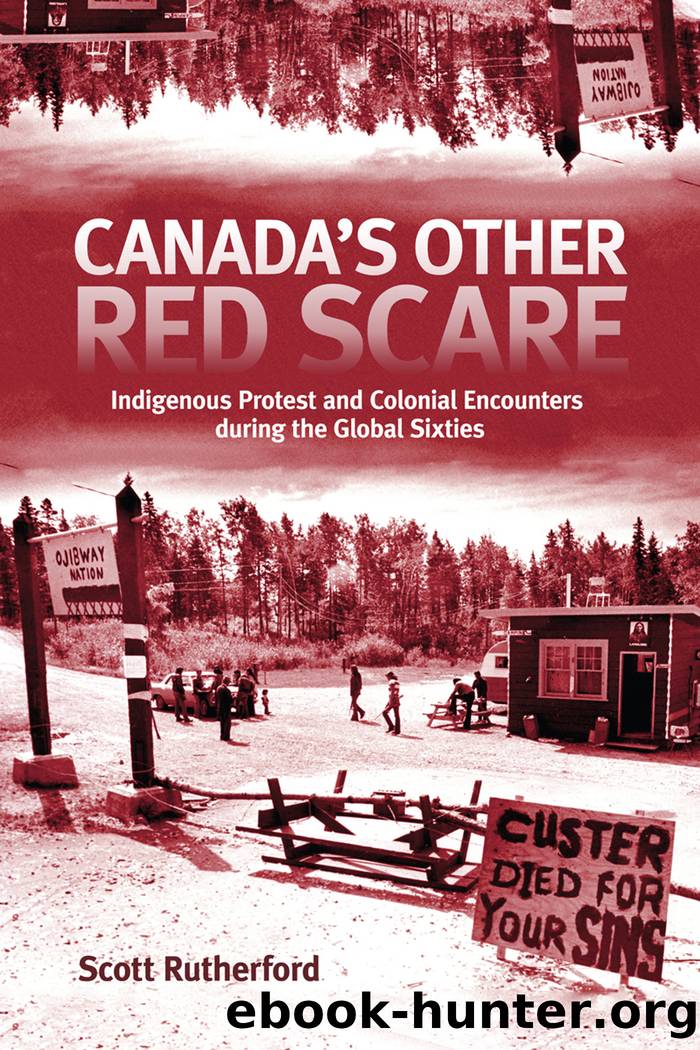
Canada's Other Red Scare by Scott Rutherford
Author:Scott Rutherford
Language: eng
Format: epub
Publisher: McGill-Queen's University Press
Published: 2020-12-14T16:00:00+00:00
CHAPTER 5
The Anicinabe Park Occupation
Red Power and the Meaning of Violence in a Settler Society
On 8 August 1974 a journalist with the Better Reads Collective, a small leftist publisher from Toronto, sat down for an extensive interview with Louis Cameron of the Ojibway Warrior Society. They were at Anicinabe Park, a fourteen-acre parcel of land on the southeast edge of Kenora which was popular with summer tourists and locals because of its lakefront location.1 At the time, the Warriors and their supporters were refusing to leave the town-owned land; armed, they were occupying it until it once again became âliberated Indian territory.â This was week three of the standoff between the Warriors on one side and the Ontario Provincial Police, the town, and the province on the other. About halfway through the interview, the reporter asked Cameron if the OWS had decided on the armed occupation of Anicinabe Park after the three levels of government failed to meet any of the demands from the sit-in at the Indian Affairs office in Kenora seven months earlier. âYes,â said Cameron.
Itâs a direct result of the takeover. We met with the Attorney-Generalâs representatives, we met the Solicitor-General, we met with the Chamber of Commerce trying to get a change for our people â some justice for our people. We talked and met in different places with these officials. We tried to meet Leo Dernier [sic], John Reid â the local politicians here â and we asked to meet with Trudeau. The Prime Minister, he donât care whatâs going on in this part of the country, and he doesnât know whatâs going on in this part of the country. Weâve asked for cabinet ministers to come down to this part of the country, weâve asked for Senators to come down to this part of the country, and nobody will get involved because they know that they cannot do anything â itâs our people that are being killed and they know it. They donât want to come down because they canât do anything. Itâs our responsibility and we have to take that responsibility. If anyone is going to do anything for our people we are going to do it â Indian people themselves will do it for Indian people.2
The group at Anicinabe Park, numbering somewhere around 150, was armed with an assortment of hunting rifles and homemade explosives, and demanded real action on a host of issues that had not only come up in the Violent Death Report the previous autumn but had been discussed since at least the Indian Rights march nine years earlier in 1965: housing, policing, jobs, water poisoning, violent deaths, and land. The park occupation was one of many actions Indigenous peoples took across Canada throughout the 1960s and 1970s. As sociologist Howard Ramos notes, the years between 1973 and 1976 saw twice as many Indigenous protest actions and legal challenges take place in Canada annually as any year between 1960 and 1969.3 Ken Coates writes that such militancy was also
Download
This site does not store any files on its server. We only index and link to content provided by other sites. Please contact the content providers to delete copyright contents if any and email us, we'll remove relevant links or contents immediately.
| Anthropology | Archaeology |
| Philosophy | Politics & Government |
| Social Sciences | Sociology |
| Women's Studies |
The Secret History by Donna Tartt(19460)
The Social Justice Warrior Handbook by Lisa De Pasquale(12290)
Thirteen Reasons Why by Jay Asher(9110)
This Is How You Lose Her by Junot Diaz(7053)
Weapons of Math Destruction by Cathy O'Neil(6460)
Zero to One by Peter Thiel(5937)
Beartown by Fredrik Backman(5927)
The Myth of the Strong Leader by Archie Brown(5623)
The Fire Next Time by James Baldwin(5578)
How Democracies Die by Steven Levitsky & Daniel Ziblatt(5321)
Promise Me, Dad by Joe Biden(5228)
Stone's Rules by Roger Stone(5184)
A Higher Loyalty: Truth, Lies, and Leadership by James Comey(5080)
100 Deadly Skills by Clint Emerson(5023)
Rise and Kill First by Ronen Bergman(4890)
Secrecy World by Jake Bernstein(4864)
The David Icke Guide to the Global Conspiracy (and how to end it) by David Icke(4841)
The Doomsday Machine by Daniel Ellsberg(4613)
The Farm by Tom Rob Smith(4598)
